
Chronicle of the 2026 World Cup Draw
he John F. Kennedy Center for the Performing Arts had never looked so football-crazy. Beneath its crystal chandeliers and marble walls, FIFA turned the stage into a temple of the beautiful game. At exactly noon local time, the lights dimmed and Gianni Infantino stepped forward wearing the grin of a man who knows he’s making history. “Welcome to the draw for the biggest World Cup ever organized,” he declared, and the auditorium erupted. Forty-eight teams, three host nations, 104 matches. The 2026 World Cup now had a face.
The ceremony kicked off with an unexpected twist: Infantino presented the inaugural “FIFA Peace Award” to former U.S. President Donald Trump. Polite applause, a few murmurs. Football, as always, mixing sport and politics in the same shaker. But the crowd hadn’t come for speeches; they had come for the balls.
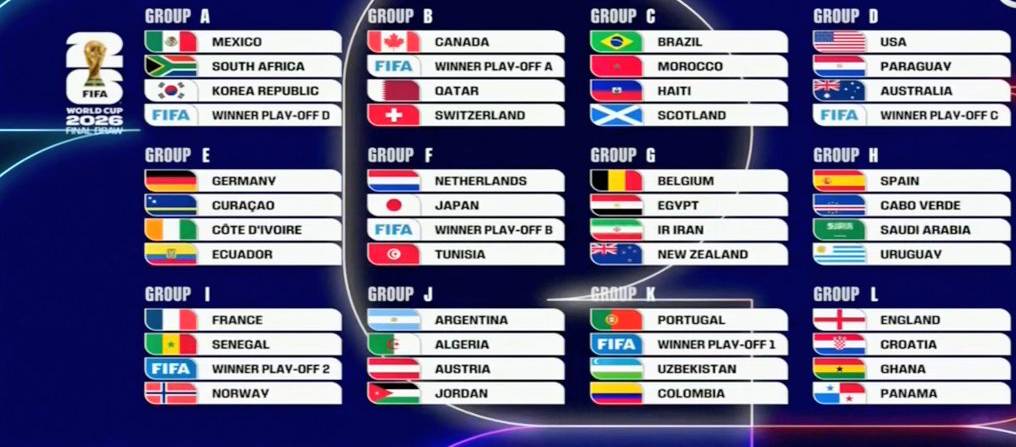
Tom Brady, Rio Ferdinand, Mexican President Claudia Sheinbaum, Javier Zanetti, and even Lauryn Hill walked the red carpet. The show was pure Hollywood with a global accent. Then the real business began: four pots, 42 teams already qualified, and six spots still up for grabs in the March play-offs. Mexico, Canada, and the United States, as hosts, already knew they would top Groups A, B, and D. Everything else was pure nerves.
The first slip of paper decided the fate of the Azteca. On June 11, 2026, Mexico will open the tournament against South Africa in the stadium that saw Maradona and Pelé become gods. South Korea and a European play-off winner will complete Group A. The Mexicans in the hall hugged; the South Africans remembered the 2010 vuvuzelas and flashed mischievous smiles. Canada breathed a sigh of relief: Switzerland, Qatar, and a European play-off winner. The United States didn’t complain either: Paraguay, Australia, and another European play-off winner. All three hosts avoided the big monsters in the first round. A good omen.
Spain landed in Group H with Uruguay, Saudi Arabia, and debutants Cape Verde. Luis de la Fuente let out a nervous laugh: “A Hollywood group.” France drew Senegal, Norway, and an intercontinental play-off winner; Germany got Curacao, Cote d’Ivoire, and Ecuador. England will have to face Croatia again, while Portugal meets Colombia. No giant complained too much, but nobody claimed victory yet either.
Brazil dropped into Group C with Morocco, Haiti, and Scotland. Neymar, watching from the stands, gave a thumbs-up. Argentina, the defending champions, will lead Group J alongside Algeria, Austria, and Jordan. Scaloni tweeted seconds later: “Manageable group, but nobody gives anything away.” Zanetti, present in Washington, added with a half-smile: “Austria can be a thorn in the side.”
Africa celebrated. Multiple qualifiers and debutants like Cape Verde. Asia sneaked in Jordan, dreaming higher than ever before. Concacaf, with Curacao, Haiti, Panama, and Costa Rica, broke its own record for representatives.
When the last ball rolled, the Kennedy Center shook. Lauryn Hill closed the night with “Killing Me Softly” while the giant screen showed the map: from the Azteca to Vancouver’s BC Place, from the Rose Bowl to Atlanta’s Mercedes-Benz, sixteen cities ready to welcome the world.
Outside on the streets of Washington, the fans were already singing. Mexicans waving green flags, Canadians in red scarves, Americans wearing Cowboys caps. All mixed together, all happy. Because it doesn’t matter which group you’re in, it doesn’t matter which play-off is still pending. What matters is that there are only 188 days left until the ball starts rolling again in North America.
The 2026 World Cup has its groups. Now it’s up to football to write the rest of the story.